When you pick up a generic pill at the pharmacy, you’re getting the same active ingredient as the brand-name version-same chemistry, same dose, same effect. But here’s the thing: generic drugs don’t go through the same safety trials as brand-name drugs before they hit the market. That’s not a flaw-it’s the law. The FDA approves generics based on bioequivalence: does it absorb the same way in your body? If yes, it’s approved. But that leaves a gap. What happens when thousands, even millions, of people take it over months or years? That’s where post-market studies come in.
Why Generic Drugs Need Extra Monitoring
Brand-name drugs are tested in clinical trials with up to 5,000 people, often healthy volunteers, under tight control. Generic drugs? They’re approved using data from the original drug. No new safety trials. That means rare side effects, interactions with other medications, or problems in older adults, pregnant women, or kids might not show up until the drug is in widespread use. The FDA estimates that 90% of all prescriptions filled in the U.S. are for generic drugs. That’s over 10,000 different products. Most are safe. But when something goes wrong-like a patch that won’t stick, a tablet that dissolves too fast, or an unexpected spike in heart palpitations-it’s not always clear which manufacturer’s version caused it. That’s why clinical follow-up after approval isn’t optional. It’s essential.How the FDA Tracks Problems After Approval
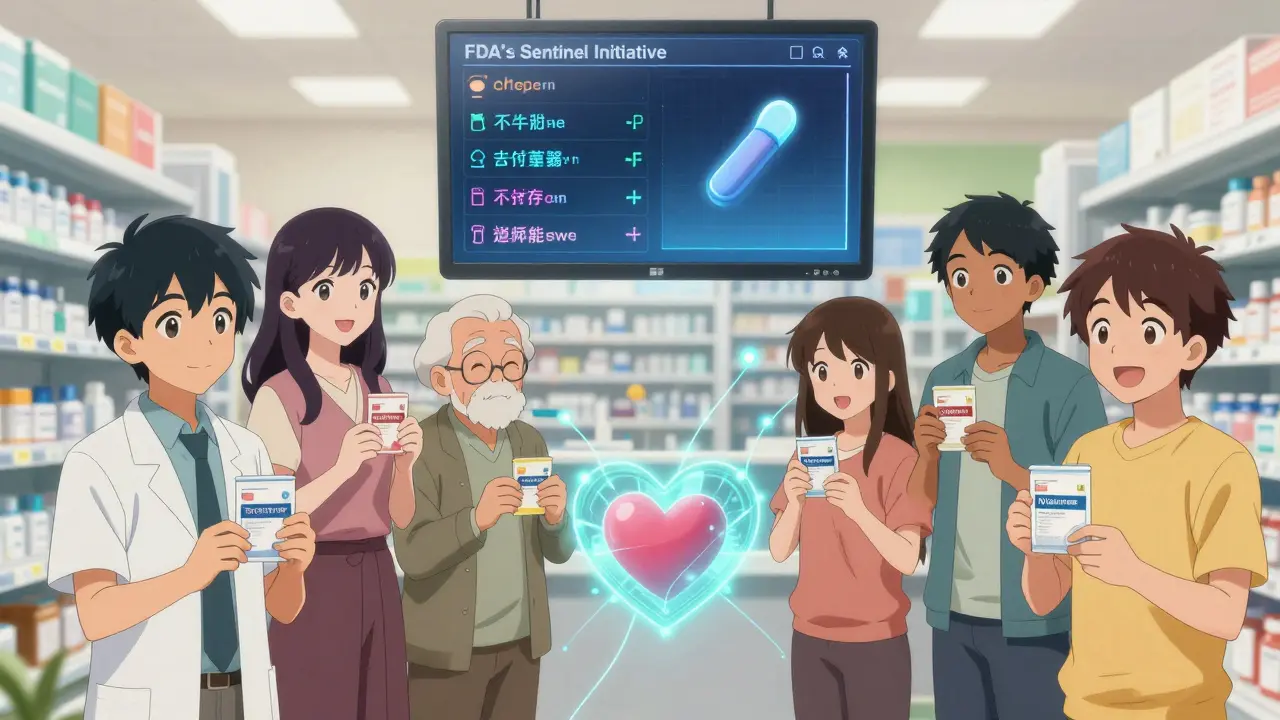
The FDA doesn’t wait for complaints. It actively hunts for signals. The Sentinel Initiative, launched in 2008 and fully online by 2016, scans health records from 300 million Americans-Medicare, Medicaid, private insurers, even VA data. It looks for patterns: Did people taking a specific generic version of blood pressure medication have more hospital visits for dizziness? Did patients on a certain generic levothyroxine show abnormal thyroid levels after switching brands? Then there’s MedWatch, the FDA’s voluntary reporting system. Doctors, pharmacists, and patients can report adverse events. In 2022, over 1.2 million reports came in. About 15% involved generic drugs. But here’s the catch: only 35% of those reports named the actual manufacturer. That makes it hard to know if the problem is with the drug itself or a specific batch from one company. The FDA also uses real-world data from electronic health records, patient registries, and even pharmacy claims. For example, if a new generic version of a seizure medication shows a 20% spike in ER visits for seizures within three months of launch, that’s a red flag. The agency then investigates: Is it the formulation? The filler? The manufacturing process?What Goes Wrong-And Why
Generic drugs are chemically identical, but they’re not physically identical. The inactive ingredients-fillers, coatings, binders-can vary. And those matter. A 2021 study in JAMA Internal Medicine found that 68% of serious adverse events linked to cardiovascular generics weren’t listed in the original drug label. Why? Because those events only appeared after long-term use in diverse populations. Common issues include:- Transdermal patches that don’t adhere properly, leading to under-dosing (27% of patch-related reports)
- Tablets that dissolve too quickly or too slowly, changing how much drug enters the bloodstream (23% of reports)
- Oral liquids forming clumps or precipitates, making dosing inconsistent
- Injectables with visible particles
Who Reports Problems-and How
Patients rarely know which generic brand they’re getting. Pharmacists often switch them without telling them. So when someone feels worse after a switch, they might blame the illness, not the drug. A 2022 survey of 1,500 U.S. physicians found that 42% had seen patients experience differences in how generic versions worked-especially with narrow therapeutic index drugs like warfarin, levothyroxine, or seizure meds. But only 18% filed formal reports. Why? Time. Paperwork. Uncertainty. Many doctors assume it’s just individual variation. On Reddit’s r/pharmacy thread in June 2023, pharmacists shared real cases: three patients developed palpitations after switching from one generic levothyroxine to another. All needed dose adjustments. One pharmacist wrote, “I’ve had four patients in six months with the same story. I call the manufacturer. They say, ‘It’s bioequivalent.’ But the patients feel different.” Meanwhile, patients on stable, low-risk meds like statins or metformin rarely report issues. A 2023 Kaiser Family Foundation study found that 89% of patients on generics for hypertension or diabetes reported no problems. Cost savings kept them on treatment. That’s a win.The Manufacturing Maze
There are over 100 generic drug manufacturers in the U.S. The top 10 control 65% of the market. But many are overseas-India, China, Israel. The FDA inspects foreign plants, but not all of them, every year. And when a drug is made by multiple companies, it’s nearly impossible to know which one caused a problem unless the report includes the lot number and manufacturer name. The FDA’s 2021 warning letter to Teva Pharmaceuticals highlighted this. Their reporting system was slow, incomplete, and failed to flag a pattern of liver enzyme spikes tied to one specific generic version. Result? Six-month delay in approving new products. Large manufacturers now use AI tools to scan reports and spot signals faster. About 78% of the top 20 generic companies use automated systems. Smaller ones? Most still rely on manual reviews. That’s a problem. One missed report can delay action for months.