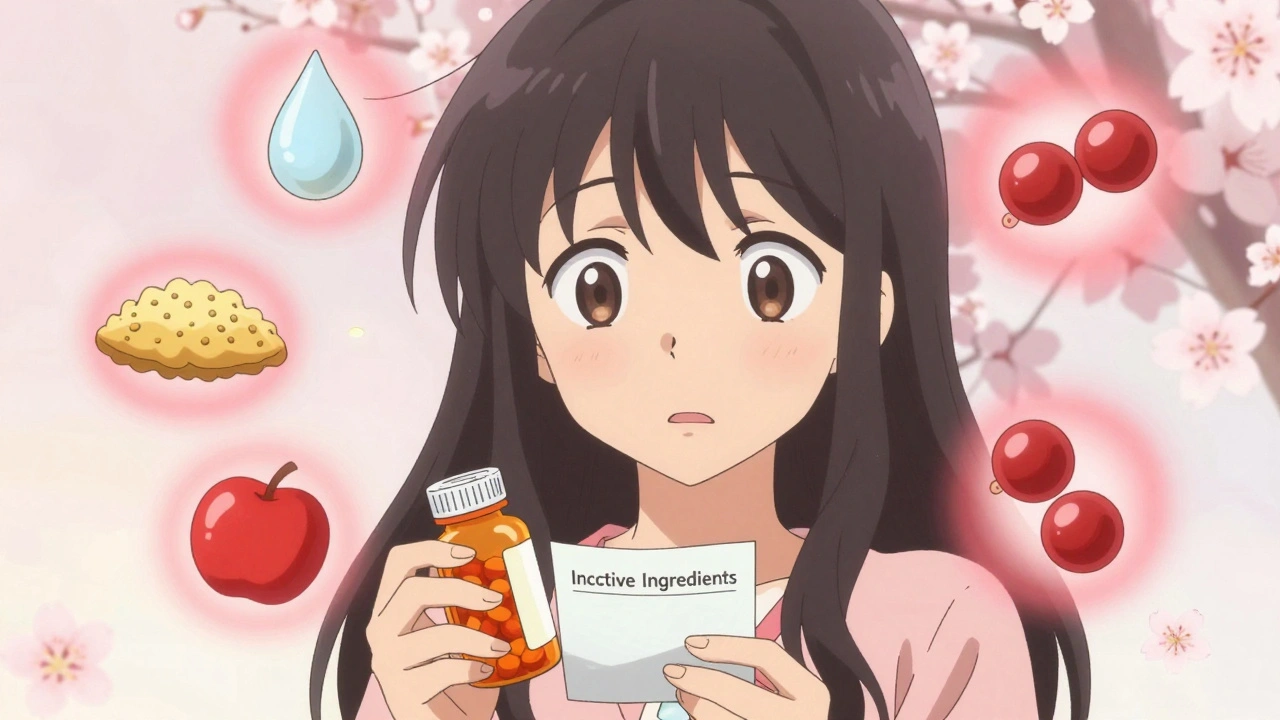
Most people assume that if two pills have the same active ingredient, they work the same way. That’s true for the drug’s intended effect-but not always for your body’s reaction to it. The real problem? inactive ingredients. These are the fillers, dyes, and preservatives that make up most of the pill. And for some people, they trigger serious reactions-even when the medicine itself is perfectly safe.
Take lactose. It’s in more than 20% of prescription drugs and 6% of over-the-counter meds. If you’re lactose intolerant or allergic to milk protein, taking a generic version of your blood pressure pill could mean stomach cramps, bloating, or worse. Same goes for gluten, food dyes like Yellow #5, soy oil, or even gelatin. These aren’t rare outliers. A 2019 study from Brigham and Women’s Hospital and MIT found that 90% of all oral medications contain at least one ingredient that could cause an adverse reaction in sensitive patients. That’s not a small risk. It’s a hidden hazard built into everyday pills.
Why Generics Can Be Riskier Than Brand Names
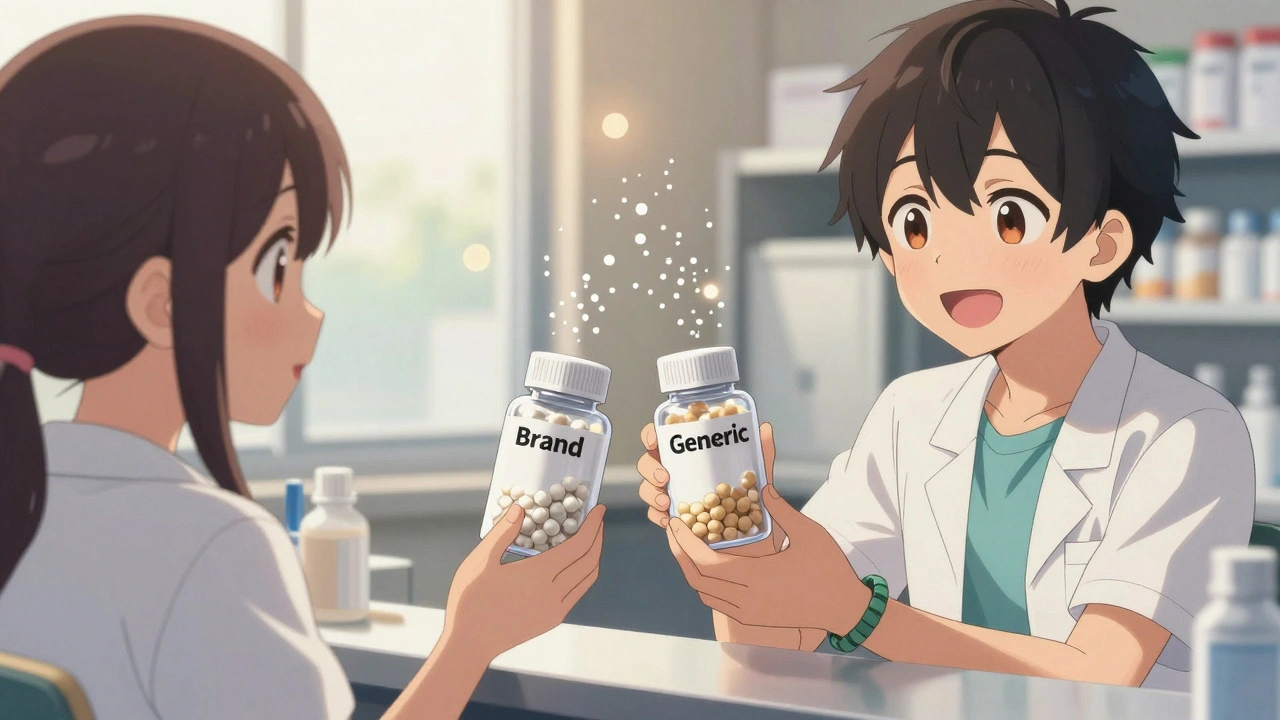
Generic drugs are required by the FDA to match the brand-name version in strength, dosage, and active ingredient. But there’s no rule saying they must match in inactive ingredients. That’s the loophole. Two pills with the same amount of lisinopril-one from the brand, one from a generic maker-can have completely different fillers. One might use lactose. The other might use cornstarch. One has Red #40 dye. The other doesn’t.
This isn’t theoretical. People switch from brand to generic-and suddenly get hives, asthma flares, or gut pain. Pharmacists report that 87% have seen patients react to this exact scenario. The Merck Manual confirms it: ‘One version, or brand, of a medication may be preferable to another’ because of excipients. And here’s the kicker: the FDA doesn’t require manufacturers to label most allergens on the bottle. Only peanut oil gets mandatory warning labels. Lactose? Gluten? Soy? No. You have to dig for that info.
What Are the Most Common Problematic Ingredients?
Not all inactive ingredients are equal. Some are harmless to nearly everyone. Others are ticking time bombs for certain people. Here are the top offenders:
- Lactose - Found in over 45% of oral meds. Especially dangerous for those with severe milk protein allergy or Celiac disease (yes, lactose can be cross-contaminated with gluten).
- Gluten - Even trace amounts can trigger reactions in Celiac patients. Some pills use wheat starch as a binder.
- Food dyes - FD&C Yellow #5 (tartrazine), Red #40, Blue #1. Linked to allergic reactions, hives, and asthma in sensitive individuals.
- Bisulfites - Used as preservatives. Can cause life-threatening asthma attacks. These are one of the few allergens that must be labeled.
- Gelatin - Often from pork or beef. Problematic for vegetarians, religious groups, or those with meat allergies.
- Soy oil - Even highly refined soy oil can trigger reactions in highly sensitive people.
- Egg proteins - Found in some vaccines and oral meds. A concern for egg-allergic children.
And here’s the twist: the same drug can have different ingredients depending on the dose. Singulair®’s 10mg tablet contains lactose. The 4mg and 5mg versions don’t. That means switching from a higher to lower dose could suddenly expose you to an allergen you never knew was there.
How to Find Out What’s in Your Medication
You won’t find this info on the pill bottle. You won’t always see it on the pharmacy label. You have to ask-and know where to look.
For over-the-counter drugs, check the ‘Drug Facts’ panel on the box. It lists inactive ingredients. For prescriptions, the paper insert that comes with your meds should have a section called ‘Inactive Ingredients.’ If it doesn’t, call your pharmacist. They have access to the full FDA-approved prescribing information.
Many pharmacies now use digital systems that flag allergens in prescriptions. Ask if your pharmacy has an allergen-filtering tool. As of 2023, 42% of U.S. pharmacies use these systems-up from just 17% in 2020. If yours doesn’t, request a printout of the full ingredient list. Don’t take ‘it’s fine’ as an answer.
There’s also a free tool called the Inactive Ingredient Finder, developed by MIT researchers and launched in beta in 2023. It lets you search over 98% of U.S. medications by name and shows every excipient in each formulation. It’s not perfect yet, but it’s the most comprehensive database available.
What to Do If You Have a Known Allergy
If you know you’re allergic to lactose, gluten, or any other excipient, don’t guess. Don’t assume your generic is safe. Follow this plan:
- Get tested - Work with an allergist to confirm exactly what you’re allergic to. Many people think they’re allergic to lactose, but it’s actually gluten or a dye causing the problem.
- Create a list - Write down every ingredient you must avoid. Keep it updated. Ingredients change without notice.
- Talk to your doctor - Before starting any new med, say: ‘I have an allergy to [ingredient]. Is there a version without it?’
- Ask your pharmacist - They’re your best ally. Say: ‘Can you check if this generic has [ingredient]? Are there alternatives?’
- Request brand or specialty generics - Some manufacturers make allergen-free versions. They’re rarer-only 12% of generics offer them-but they exist. Ask for them by name.
- Monitor after switching - Even if you’ve taken a med before, if the manufacturer changed, the ingredients might have too. Watch for symptoms for 48 hours after any switch.
For Celiac patients, the Celiac Disease Foundation says only about 15% of prescription drugs are verified gluten-free. Don’t trust ‘gluten-free’ claims unless they’re certified. And remember: ‘gluten-free’ on a food label doesn’t mean the same thing as on a pill.
Why This Isn’t Getting Fixed Faster
It’s not for lack of awareness. The 2019 MIT study shocked the medical world. The FDA held a public workshop in 2021. They drafted new labeling rules in 2022-requiring clear warnings for lactose, gluten, soy, sulfites, dyes, gelatin, and shellfish derivatives. But as of late 2025, those rules are still not final. No deadline. No enforcement.
In Europe, things are different. Since 2019, the EMA has required full disclosure of all excipients. Adverse reactions dropped by 37%. In the U.S., only 68% of big pharma companies have voluntarily improved labeling. Most haven’t.
Why? Because changing labels costs money. Because generics are cheap by design-and adding allergen info adds steps. Because regulators still treat excipients as ‘harmless unless proven otherwise.’ But for the 1 in 1,000 people who have a real reaction, it’s not hypothetical. That’s 330,000 Americans a year.
What’s Changing-and What You Can Do Now
Change is coming, slowly. By 2027, IQVIA predicts 30% of new generic drugs will offer at least one allergen-free version. Payors (insurance companies) are starting to incentivize safer formulations. Pharmacies are upgrading their software. Patients are speaking up.
But waiting for the system to fix itself isn’t an option. You have to be your own advocate. If you’ve had an unexplained reaction after switching meds-itching, swelling, stomach pain, breathing trouble-don’t brush it off. It might not be the drug. It might be the filler.
Next time you get a prescription, ask: ‘What’s in this pill besides the medicine?’ Don’t be embarrassed. Don’t assume it’s not important. Your body isn’t reacting to the active ingredient. It’s reacting to something else-and you deserve to know what it is.
There’s no magic pill that makes this easy. But with the right questions, the right tools, and the right team-your pharmacist, your doctor, your allergist-you can avoid the hidden dangers in your medicine cabinet.
Can generic medications cause allergic reactions even if they have the same active ingredient as the brand name?
Yes. Generic medications must match the brand-name version in active ingredient strength and absorption, but they can-and often do-use different inactive ingredients like lactose, gluten, dyes, or preservatives. These excipients can trigger allergic reactions or intolerances in sensitive individuals, even when the active drug is identical.
How do I find out what inactive ingredients are in my medication?
Check the patient information leaflet that comes with your prescription. If it’s not there, ask your pharmacist for the full FDA-approved prescribing information. For over-the-counter drugs, look at the ‘Drug Facts’ label on the box. You can also use the free MIT-developed ‘Inactive Ingredient Finder’ app to search over 98% of U.S. medications.
Are there any medications that are guaranteed to be free of common allergens like lactose or gluten?
Yes, but they’re rare. Only about 12% of generic medications currently offer allergen-free formulations. Some manufacturers produce versions without lactose, gluten, or dyes-often labeled as ‘hypoallergenic’ or ‘free from.’ You’ll need to ask your pharmacist specifically for these options. Brands like Teva, Mylan, and Amneal sometimes offer them, but availability changes frequently.
Why don’t drug labels list all allergens like food labels do?
U.S. regulations only require labeling for a few high-risk ingredients like peanut oil and bisulfites. Lactose, gluten, soy, and food dyes are not mandatory to disclose-even though they’re common triggers. The FDA proposed new rules in 2022 to fix this, but they haven’t been finalized. In contrast, the European Union requires full excipient disclosure, which has cut adverse reactions by 37%.
What should I do if I suspect I’m reacting to an inactive ingredient?
Stop the medication and contact your doctor immediately. Keep a symptom diary-note when you took the drug, what symptoms appeared, and how long they lasted. Ask your allergist to test for sensitivities to common excipients. Then, work with your pharmacist to find a version without the culprit ingredient. Never assume a new prescription is safe just because the active ingredient is the same.
Is it safe to switch between different generic brands of the same medication?
Not always. Different generic manufacturers use different fillers. Switching between generics-even for the same drug-can expose you to new allergens. For example, one brand’s generic lisinopril might contain lactose; another’s might use cornstarch. Always verify the ingredients each time you refill, even if you’ve taken the same generic before.
Are children more at risk for reactions to inactive ingredients?
Yes. Children are more vulnerable because they often take multiple medications and have higher sensitivity to allergens like lactose and egg proteins. Pediatric formulations frequently use dyes and flavorings to make pills palatable, which increases exposure. Dr. Robert Wood at Johns Hopkins notes that milk protein allergy in infants is often triggered by lactose in liquid or chewable medications. Always check ingredients before giving any new drug to a child.
If you take five or more pills a day-common for older adults-you’re likely consuming multiple allergens at once. That’s not just risky. It’s a silent health crisis. The fix isn’t simple. But knowing what’s in your pills? That’s the first step.