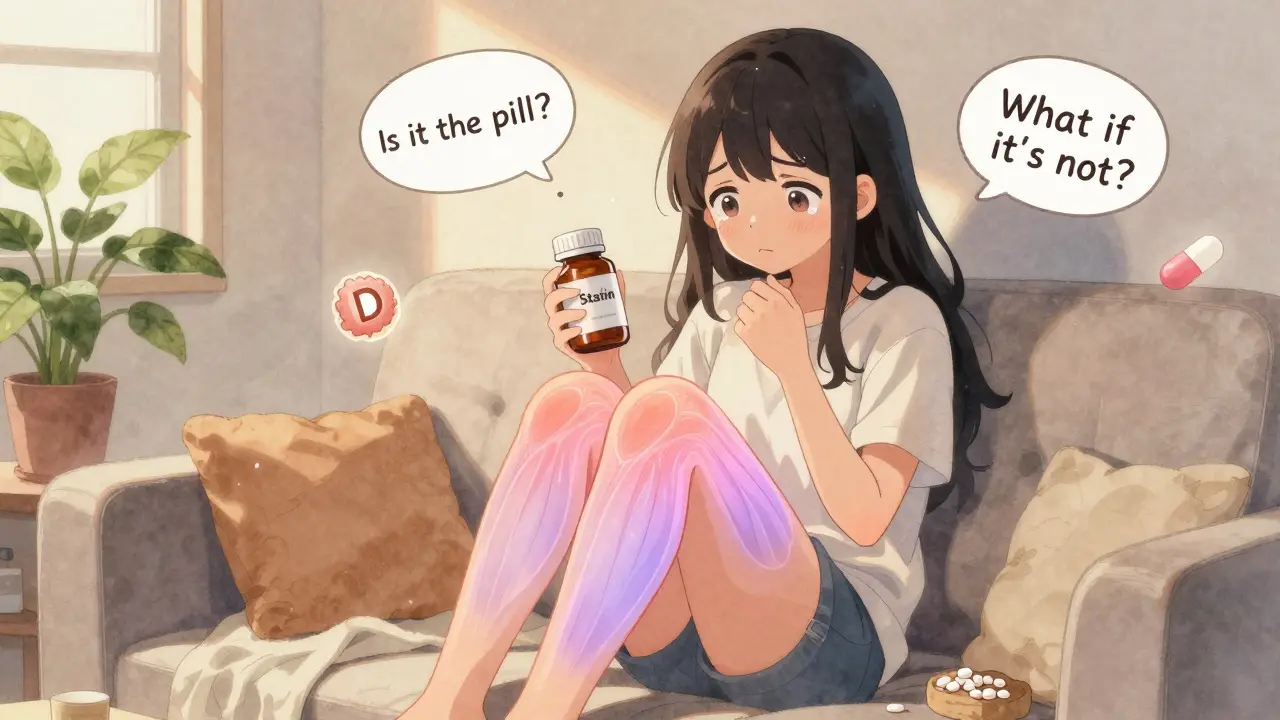
Many people start statins to lower their cholesterol and protect their heart - but then the muscle pain begins. Thighs feel heavy. Legs ache after walking. Shoulders won’t lift. It’s not just discomfort - it’s fear. You stop the pill. And suddenly, you’re left wondering: Is this really the statin? Or is it something else?
Statin Muscle Pain Isn’t Always What It Seems
About 90% of people who say they can’t take statins report muscle symptoms. But here’s the twist: in nearly 9 out of 10 of those cases, the pain isn’t actually caused by the drug. A major study called SAMSON found that people felt muscle aches just as often when they were taking a sugar pill as when they were on statins. That’s the nocebo effect - your brain expecting side effects, so your body feels them, even without the drug. The truth? Most muscle pain people blame on statins comes from other sources: aging joints, vitamin D deficiency, thyroid problems, or even just getting older. One study showed that 41% of people labeled as statin-intolerant actually had osteoarthritis. Another 29% were low on vitamin D. These aren’t rare. They’re common. And they’re fixable.What Real Statin Intolerance Looks Like
True statin intolerance isn’t just feeling sore. It’s defined by strict rules. According to the National Lipid Association (2022), you must be unable to take two different statins - one at the lowest dose, another at any dose - because of symptoms that show up after starting the drug, go away when you stop, and come back if you try again. Only then is it officially intolerance. Symptoms usually show up within 30 days of starting or increasing the dose. They’re typically symmetric - both legs, both shoulders. You might feel heaviness, stiffness, or cramps more than sharp pain. You might struggle to stand up from a chair or raise your arms. But here’s the key: your creatine kinase (CK) blood level is almost always normal or only slightly high. If it’s more than four times the normal range, that’s a different problem - like myositis or rhabdomyolysis. Those are extremely rare. Only about 2 in a million statin users get rhabdomyolysis. That’s less than one case per day in the entire U.S.Why So Many People Stop Statins - and Why They Shouldn’t
About half of all people who start statins stop within a year. Muscle pain is the top reason. But here’s the danger: stopping statins without a real diagnosis increases your risk of heart attack or stroke by up to 25%. Statins aren’t just pills - they’re proven shields. For someone with high cholesterol and a history of heart disease, skipping them could cost years of life. The problem isn’t the statin. It’s the misdiagnosis. Too many doctors skip the rechallenge step - where you stop the statin, wait a few weeks, then try it again. If the pain doesn’t come back, it wasn’t the drug. But most patients never get this test. They’re told, “It’s the statin,” and they’re never offered another option.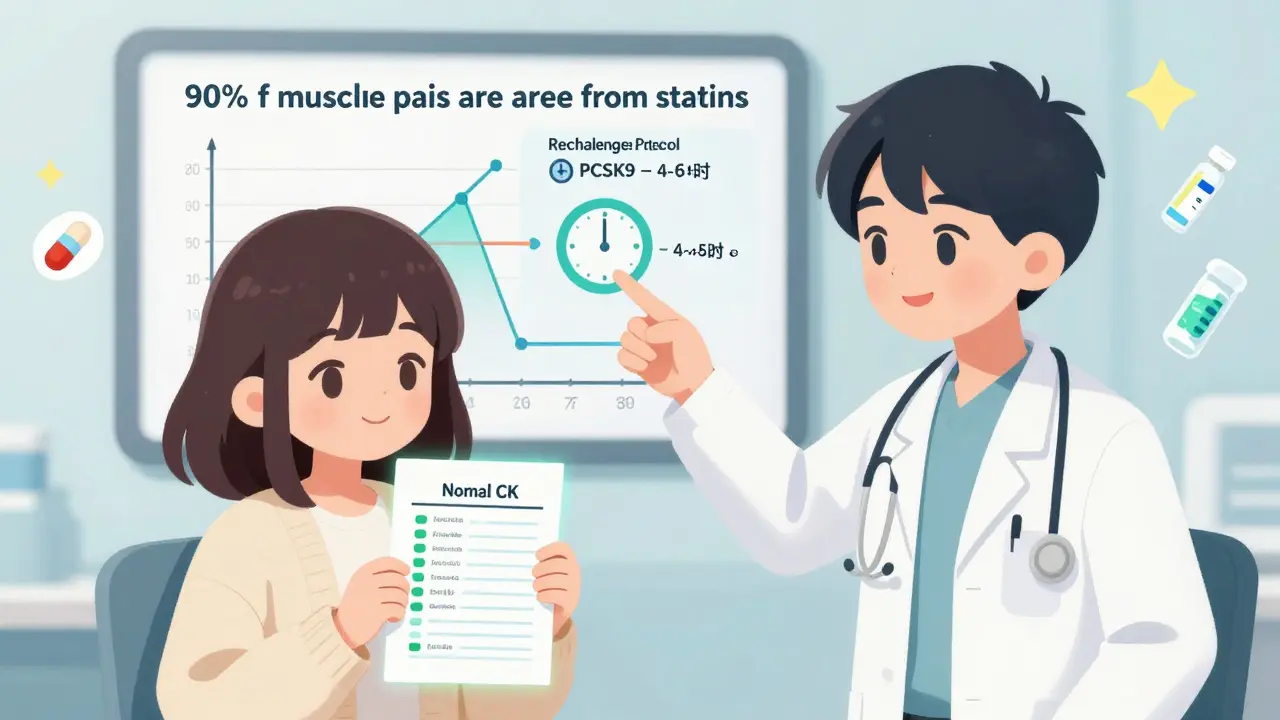
Alternatives That Actually Work
If you’ve been told you’re statin-intolerant, don’t give up. There are other ways to lower cholesterol - and many of them work better than you think. Ezetimibe is the easiest next step. It’s a daily pill that blocks cholesterol absorption in your gut. It lowers LDL by about 18%, works well with or without statins, and has almost no side effects. In fact, 94% of people can stick with it after a year. It’s cheap - often under $10 a month. Bempedoic acid is newer. It works in the liver, not the muscles, so it’s less likely to cause pain. It lowers LDL by 17% and is taken as a daily tablet. It’s also been shown to reduce heart attacks and strokes in high-risk patients. Tolerability? Around 88%. PCSK9 inhibitors like evolocumab are injectables given every two weeks. They slash LDL by nearly 60%. That’s more than most statins. They’re safe for muscles - no muscle pain reported in trials. The catch? Cost. At $5,800 a year, they’re expensive. But insurance often covers them if you’ve tried and failed two statins and ezetimibe. And many patient assistance programs bring the price down to under $50 a month. Colesevelam is a bile acid binder. It comes as a pill and lowers LDL by 15-18%. But it can cause bloating or constipation. It’s not for everyone, but for those who can tolerate it, it’s a solid option.What to Do If You Think You’re Intolerant
Here’s a clear plan if you’re struggling with muscle pain on statins:- Don’t quit cold. Talk to your doctor before stopping.
- Check your vitamin D. Levels below 20 ng/mL are common and can cause muscle pain. Supplementing helps.
- Test your thyroid. Hypothyroidism affects 12% of people misdiagnosed with statin intolerance.
- Try a different statin. Hydrophilic statins like pravastatin or rosuvastatin are less likely to cause muscle issues than lipophilic ones like simvastatin. About 65% of people who can’t take one statin can handle another.
- Try low-dose statin. A 10mg dose of atorvastatin lowers LDL by 32% and is tolerated by 89% of people.
- Ask for a rechallenge. Stop the statin for 4-6 weeks. If symptoms disappear, restart the same dose. If they come back, it’s likely the drug. If not, it’s something else.
- Consider intermittent dosing. Some people do well on rosuvastatin 600mg once a week - that’s 20mg daily equivalent, but spread out. It reduces muscle symptoms while keeping LDL down.

What About CoQ10?
You’ve probably heard that CoQ10 helps with statin muscle pain. It makes sense - statins lower CoQ10, and CoQ10 helps muscles. But the science is weak. Double-blind studies show only 34% of people report benefit - no better than placebo. It’s safe to try, but don’t expect miracles. Save your money for proven options.What’s Coming Next
The future of statin intolerance is better testing and better drugs. Genetic testing for the SLCO1B1 gene variant can now predict who’s at higher risk for muscle side effects. By 2025, doctors may screen patients before prescribing statins, cutting intolerance rates by up to 25%. New drugs are on the horizon. Inclisiran is a twice-yearly shot that lowers LDL by 50% and has 93% adherence. Oral PCSK9 inhibitors like MK-0616 are in late-stage trials - pills that work like injectables. And drugs like IMOD3001 aim to protect muscles while letting statins do their job.You’re Not Alone - and You’re Not Out of Options
If you’ve been told you can’t take statins, you’re not broken. You’re just misdiagnosed. The real issue isn’t that statins don’t work - it’s that we’ve been too quick to blame them. Muscle pain is common. Heart disease is deadly. But you don’t have to choose between the two. With the right steps - proper testing, smarter drug choices, and patience - more than 90% of people labeled statin-intolerant can find a way to lower their cholesterol safely. You don’t need to live with high LDL. You just need the right plan.Can statins cause permanent muscle damage?
No, statins do not cause permanent muscle damage in the vast majority of cases. Muscle symptoms from statins are temporary and resolve completely within weeks after stopping the medication. Severe conditions like rhabdomyolysis - which can cause kidney damage - are extremely rare, occurring in fewer than 2 out of every million prescriptions. If symptoms persist after stopping statins, another cause like thyroid disease, vitamin deficiency, or an autoimmune condition should be investigated.
How long should I stop statins before trying again?
Wait 4 to 6 weeks after stopping the statin before re-challenging. This gives your body time to clear the drug and lets muscle symptoms fully resolve. If symptoms return when you restart the same statin at the same dose, it’s likely a true intolerance. If they don’t return, your original pain was probably unrelated to the statin.
Is it safe to take statins every other day or once a week?
Yes, for some people, intermittent dosing works. Studies show that taking rosuvastatin 600mg once a week (equivalent to 20mg daily) reduces LDL by nearly 50% in most patients while significantly lowering muscle symptoms. This approach isn’t for everyone, but it’s a proven strategy for those who can’t tolerate daily dosing. Always work with your doctor to find the right schedule.
Can I just rely on diet and exercise instead of medication?
Diet and exercise help - but not enough for most people with high cholesterol and heart disease risk. Even the best lifestyle changes typically lower LDL by only 10-15%. For someone with a history of heart attack, diabetes, or very high LDL, that’s not enough protection. Medications like ezetimibe or PCSK9 inhibitors are often needed to reach target levels. Lifestyle is the foundation - but not the whole solution.
Why do some doctors say statins are always safe while others say they’re dangerous?
It’s about context. Statins are safe for most people - the risk of serious muscle damage is extremely low. But for a small group, muscle symptoms are real and disabling. The problem isn’t the drug itself - it’s how we diagnose intolerance. Doctors who say statins are always safe are focusing on the data from clinical trials. Those who warn about danger are seeing real patient suffering in clinics. The truth is in between: statins work, but we need better tools to tell who truly can’t take them.