Ever tried cutting calories, counting macros, and hitting the gym-only to watch the scale barely budge? You’re not failing. Your circadian rhythm might be working against you. This isn’t about willpower. It’s biology. When your sleep schedule clashes with your body’s internal clock, your metabolism slows down, your hunger hormones go haywire, and your body starts storing fat-even if you’re eating the same amount as before.
What Your Body Does When You Sleep (And What Happens When You Don’t)
Your body runs on a 24-hour cycle called the circadian rhythm. It’s not just about feeling tired or awake. Every organ, from your liver to your fat cells, has its own clock synced to a master timer in your brain. These clocks control when you burn calories, when you store fat, when your insulin sensitivity peaks, and when your appetite spikes. When you sleep on a regular schedule-say, 11 p.m. to 7 a.m.-your metabolism runs like a well-oiled machine. But when you flip that schedule-working nights, scrolling until 2 a.m., or eating dinner at midnight-your internal clocks get out of sync. This is called circadian misalignment. And it’s not a minor glitch. A 2014 study in PNAS found that night shift workers burn about 55 fewer calories per day than people on a normal schedule. That’s the equivalent of skipping a small snack. Sounds harmless? Multiply that over a year, and you’re looking at nearly 8 pounds of extra weight gain-just from misaligned sleep.Why Late-Night Eating Makes You Gain Weight
Your body expects food during daylight. That’s when your digestive system is primed to process nutrients. At night, it’s in repair mode. When you eat after dark, your body doesn’t know what to do with the calories. Glucose tolerance drops by 15-30% during biological night hours. Insulin sensitivity falls by 20-25%. That means more sugar stays in your blood, gets converted to fat, and gets stored-especially around your belly. A study in Nature Reviews Endocrinology showed that eating late doesn’t just mess with glucose. It cuts the thermic effect of food-the energy your body uses to digest-by 17%. So you’re not only storing more fat, you’re burning fewer calories just to process your meal. And it’s not just about what you eat. It’s when. One experiment found that people who ate the same number of calories, but only between 8 a.m. and 6 p.m., lost more weight than those who ate the same meals spread out until midnight. The timing made the difference.Why You Crave Chips at 2 a.m.
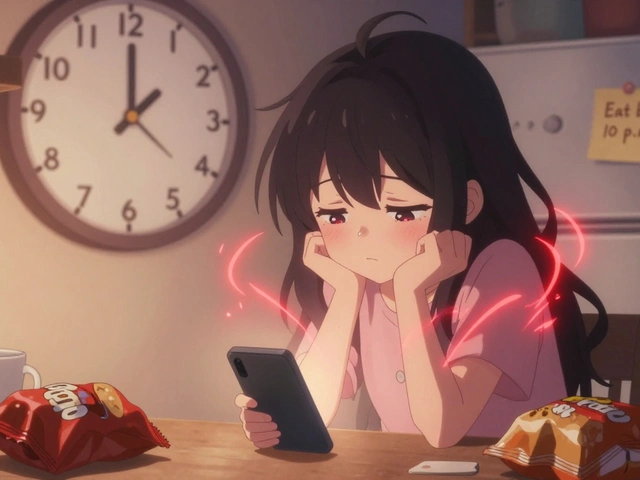
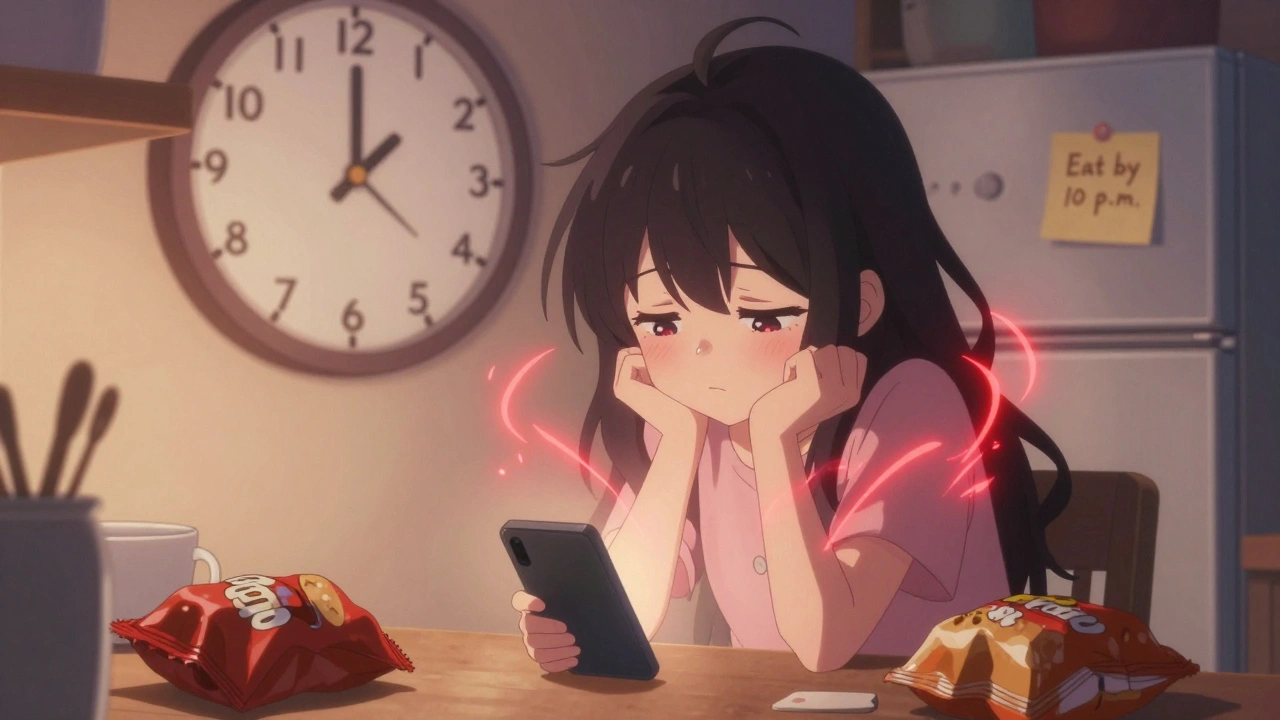
Sleep loss doesn’t just slow your metabolism-it rewires your brain. A 2016 study from the University of Chicago showed that when people slept only 4 hours a night for four days, their appetite jumped 22%. Their cravings for high-carb, high-fat foods like pizza, cookies, and chips went up by 33%. Brain scans revealed their reward centers lit up like fireworks when they saw pictures of junk food. This isn’t weakness. It’s biology. Your body thinks you’re in survival mode. When you’re tired, your brain thinks you need quick energy. So it pushes you toward fast-burning carbs. That’s why you reach for a bag of chips instead of an apple at 3 a.m.-your brain is screaming for fuel, even though your body doesn’t need it.
Shift Workers and the Hidden Weight Gain Epidemic
About 20% of the global workforce works nights or rotating shifts. That’s hundreds of millions of people whose bodies are constantly out of sync. Studies show they gain 2.5 kilograms (over 5 pounds) more over two years than day workers-even when their diets are identical. On Reddit’s r/ShiftWork subreddit, 78% of 1,245 respondents said they gained weight after starting night shifts. One nurse wrote: “I gained 35 pounds in my first year. I ate the same food. I just couldn’t stop snacking at 3 a.m.” This isn’t anecdotal. It’s a pattern backed by data. The Endocrine Society reviewed 27 studies involving 285,000 people and concluded that circadian misalignment accounts for 5-10% of obesity risk in shift workers-on top of diet and exercise habits.Time-Restricted Eating: The Simple Fix
You don’t need to quit your job or sleep 10 hours a night to fix this. One of the most effective tools is time-restricted eating (TRE)-eating all your meals within a 10-hour window during daylight hours. A 2019 study from the Salk Institute found that overweight adults who ate only between 8 a.m. and 6 p.m. lost 3-5% of their body weight in 12 weeks. No calorie counting. No fancy diets. Just eating within a 10-hour window. The best part? It works even if you’re not a morning person. Morning types (people who naturally wake up early) do best with an 8 a.m. to 6 p.m. window. Evening types (night owls) do better with a 10 a.m. to 8 p.m. window. The key is consistency. Eat at the same times every day-even on weekends. A 2022 survey of 450 people using the Zero app found those who stuck to a 10-hour eating window lost 3.2 kg (7.1 lbs) more over 12 weeks than those who didn’t. And 74% said their nighttime hunger disappeared.Why Most Diets Fail (And Why This Works)
Traditional weight loss advice focuses on calories in, calories out. But that ignores timing. Two people can eat the same 1,800 calories a day. One eats them between 7 a.m. and 7 p.m. The other eats half after midnight. The second person will gain weight. The first will lose it. Circadian rhythm doesn’t care how many calories you eat. It cares when you eat them. Your body burns calories differently at 8 a.m. than it does at 10 p.m. That’s why crash diets often fail-they don’t fix the rhythm. And unlike extreme diets, TRE is sustainable. You don’t eliminate foods. You just shift when you eat them. No supplements. No pills. Just aligning your eating with your biology.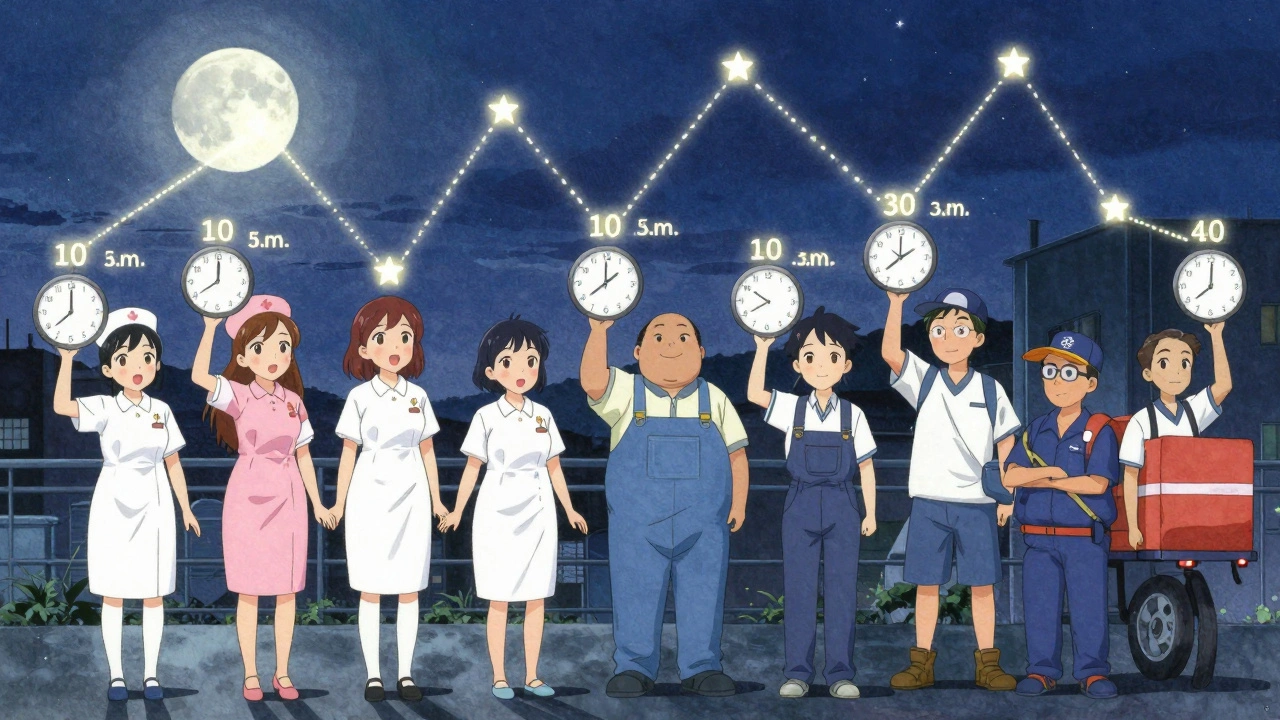
What to Do If You Work Nights
If you work nights, you can’t just flip your schedule to match the sun. But you can still optimize. Here’s how:- Keep your sleep schedule consistent-even on days off. Try to sleep at the same time every day.
- Eat your main meal before your shift. Avoid heavy meals during your night shift.
- Use bright light during your active hours (even if it’s nighttime). Exposure to light helps reset your clock.
- Block blue light after your shift. Wear blue-light-blocking glasses or use apps like f.lux to dim screens.
- Try a 10-hour eating window that matches your active hours. If you work 11 p.m. to 7 a.m., eat between 5 p.m. and 3 a.m. Then sleep. Don’t eat after you wake up.