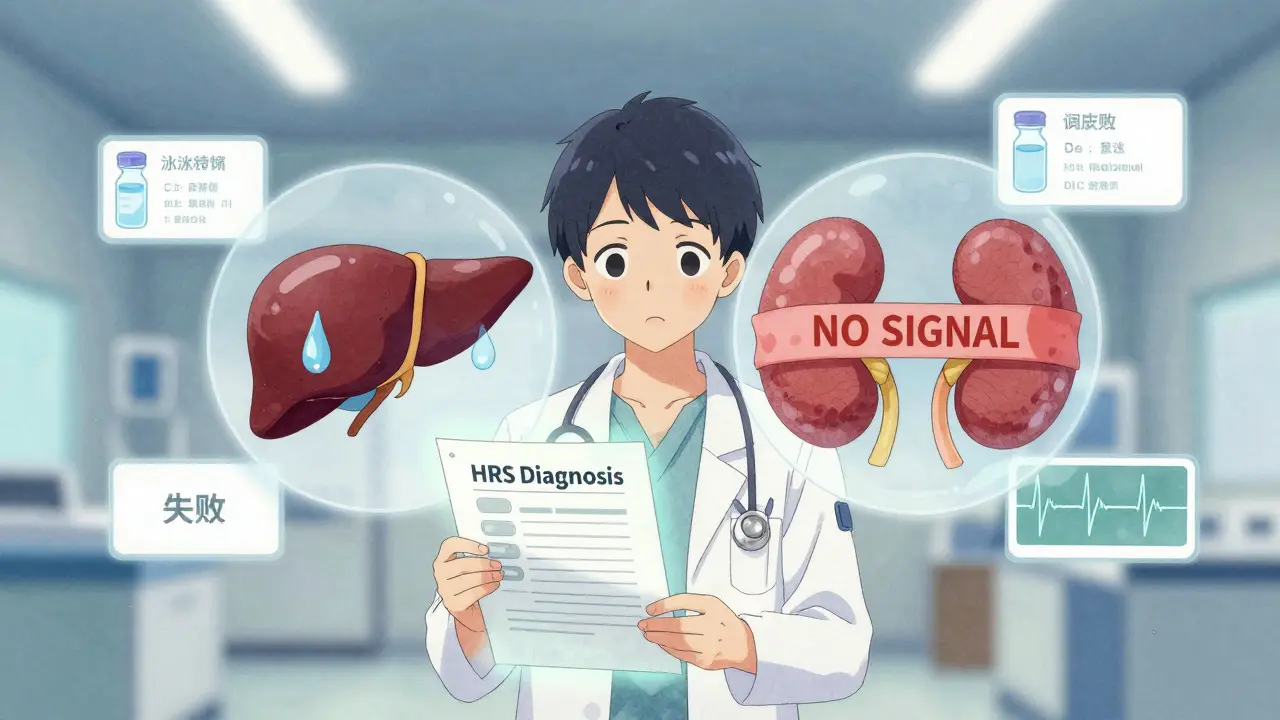
When your liver is severely damaged-especially from cirrhosis-it doesn’t just affect your liver. It can shut down your kidneys too. This isn’t a coincidence. It’s a medical emergency called hepatorenal syndrome (HRS). It happens in about 1 in 10 hospitalized patients with advanced liver disease, and nearly 4 out of 10 people with end-stage liver disease will develop it. The kidneys aren’t broken. They’re not scarred or blocked. They’re just not getting the right signals to work. And that’s what makes HRS so dangerous: it looks like kidney failure, but the fix isn’t dialysis alone. It’s fixing the liver’s chaos first.
What Exactly Is Hepatorenal Syndrome?
There are two types. Type 1 HRS is the emergency. Creatinine jumps to over 2.5 mg/dL in less than two weeks. Survival without treatment? Just two weeks on average. Type 2 is slower. Creatinine stays between 1.5 and 2.5 mg/dL. It’s tied to stubborn ascites-fluid in the belly that won’t go away even with strong diuretics. Both types mean you’re in serious trouble. But Type 1 is a race against time.
How Do Doctors Diagnose It?
You can’t just test for HRS. You have to rule everything else out. That’s why so many cases are missed or misdiagnosed. A 2020 audit found that 30% of patients got the wrong diagnosis. Here’s what doctors check:
- Is creatinine rising fast? (Type 1: doubles in under 2 weeks)
- Is urine sodium below 10 mmol/L? (Low = kidneys are holding onto salt because of poor blood flow)
- Is urine osmolality higher than blood? (That’s a sign your kidneys are trying to conserve water)
- Is there no protein in urine? (More than 500 mg/day? Probably not HRS)
- Is there no blood in urine? (Over 50 red blood cells? Likely another kidney problem)
- Did fluid and albumin help? (If you give 1 gram per kg of body weight of albumin for two days and nothing changes? HRS is likely)
And here’s the kicker: a kidney biopsy will show nothing wrong. That’s how you know it’s functional-not structural. The kidneys are fine. The body’s system is broken.
What Triggers It?
It doesn’t just happen out of nowhere. In nearly 7 out of 10 cases, something pushes the liver disease over the edge. The biggest trigger? Spontaneous bacterial peritonitis (SBP)-an infection in the belly fluid. It happens in 35% of HRS cases. Other triggers:
- Upper GI bleeding (22%)
- Alcoholic hepatitis (11%)
- Overuse of diuretics or NSAIDs
- Large-volume paracentesis without albumin replacement
If you have cirrhosis and develop fever, abdominal pain, or confusion-get checked immediately. That’s often the first sign something’s going wrong with your kidneys too.
How Is It Treated?
There’s no magic pill. But there are proven steps that can save lives.
Step 1: Stop the damage. Discontinue NSAIDs, diuretics, and any other drugs that hurt the kidneys. Start IV albumin-1 gram per kilogram of body weight on day one (up to 100g), then 20-40g daily. This helps restore blood volume and improves kidney function.
Step 2: Use vasoconstrictors. For Type 1 HRS, the gold standard is terlipressin. It tightens blood vessels in the abdomen, which helps restore blood flow to the kidneys. In clinical trials, it worked in 44% of patients. But it’s not easy. It can cause severe abdominal pain, heart rhythm issues, or even limb ischemia. Dosing is tricky. One patient shared online: “My creatinine dropped from 3.8 to 1.9 in 10 days, but I had to cut the dose because of pain.”
In the U.S., terlipressin (brand name Terlivaz™) was approved in December 2022. It costs about $1,100 per vial. A 14-day course? Around $13,200. Many insurers still fight coverage. In places without access to terlipressin, doctors use a combo of midodrine and octreotide. It’s less effective but often the only option.
For Type 2 HRS, especially with stubborn ascites, a TIPS procedure (a shunt placed inside the liver) can help. It redirects blood flow and improves kidney function in 60-70% of cases. But it comes with a risk: 30% of patients develop hepatic encephalopathy-brain fog or confusion from liver toxins.
Why Transplant Is the Only Real Cure
Medications can stabilize HRS. But they don’t fix the root cause. Only liver transplantation does.
Survival stats tell the story:
- With vasoconstrictors + albumin: 38.7% survive one year
- With just supportive care: 18.2% survive one year
- After liver transplant: 71.3% survive one year
That’s why experts now recommend listing for transplant as soon as Type 1 HRS is diagnosed-even if the creatinine improves with treatment. The 2023 European Liver and Intestine Transplant Association guidelines say: don’t wait. If you have HRS, you’re already on the fast track.

What’s New in HRS Research?
There’s hope beyond transplants and terlipressin. Researchers are testing new tools:
- NGAL biomarker: A urine test for neutrophil gelatinase-associated lipocalin may predict HRS before creatinine rises. A trial called PROGRESS-HRS is validating if a level above 0.8 ng/mL signals high risk.
- Alfapump®: A device implanted in the abdomen that automatically removes ascites fluid. It’s being tested for Type 2 HRS and could replace repeated paracentesis.
- New vasopressin drugs: Drugs like PB1046 are in Phase 3 trials. They could offer safer alternatives to terlipressin.
Also, MELD-Na scores-the system used to prioritize transplant patients-now include kidney function. That means HRS patients get higher priority. In 2022, transplant allocation for HRS patients jumped by 15-20%.
Why Diagnosis Is Still So Hard
Only 58% of non-specialist doctors correctly identify HRS in case studies. Why? Because it looks like other kidney problems. And many hospitals don’t have protocols. A 2022 survey found only 35% of U.S. hospitals had formal HRS guidelines. At academic centers, hepatology teams handle these cases. In community hospitals? Often, it’s guesswork.
Patients report delays of over a week on average. One survey of 312 families found 63% had been misdiagnosed at least once. Insurance denials are common-even when criteria are met. That’s why knowing the signs matters.
What Should You Do If You or a Loved One Has Cirrhosis?
- Monitor for sudden swelling in the belly, legs, or face
- Watch for reduced urine output
- Check for confusion, fatigue, or nausea
- Ask your doctor: “Could this be hepatorenal syndrome?”
- insist on albumin if you’re getting fluid drained from your belly
- Request a liver specialist consult if kidney function drops
HRS doesn’t come with a warning light. But if you’re living with cirrhosis, you’re already at risk. Knowledge is your best defense.
Is hepatorenal syndrome the same as acute kidney injury?
No. Acute kidney injury (AKI) is a broad term for any sudden drop in kidney function. HRS is a specific type of AKI that happens only in people with advanced liver disease. It’s diagnosed by exclusion-other causes like dehydration, infection, or blockages must be ruled out first. The kidneys in HRS are structurally normal, unlike in other forms of AKI where there’s actual damage.
Can hepatorenal syndrome be reversed without a transplant?
Yes, in some cases. About 40-45% of Type 1 HRS patients respond to terlipressin and albumin, with creatinine dropping below 1.5 mg/dL. Type 2 HRS can improve with TIPS or long-term vasoconstrictor therapy. But these are temporary fixes. Without a transplant, the underlying liver disease keeps progressing. Most patients who respond to treatment still need a transplant eventually.
Why is terlipressin not widely available in the U.S.?
Terlipressin was approved in the U.S. in December 2022, but it’s expensive-around $13,200 for a two-week course. Many insurers require prior authorization or deny coverage unless other treatments fail. It’s also not stocked in most community pharmacies. Only transplant centers and major hospitals typically carry it. This creates access gaps, especially in rural areas.
Does drinking alcohol make hepatorenal syndrome worse?
Yes. Alcohol continues to damage the liver even after HRS develops. If you’re diagnosed with HRS, stopping alcohol is non-negotiable. Continued drinking increases the risk of infection, bleeding, and rapid progression. It also disqualifies you from transplant listing. Abstinence is the first step toward any recovery.
What’s the survival rate after a liver transplant for HRS?
One-year survival after transplant for HRS patients is about 71%. That’s significantly higher than medical management alone (under 20%). Transplant doesn’t just fix the liver-it reverses the kidney failure. The kidneys often recover on their own once the liver is replaced. Early listing is key: patients who get transplanted within 30 days of HRS diagnosis have the best outcomes.
Can HRS happen in people without cirrhosis?
Rarely. HRS is almost always linked to cirrhosis or acute-on-chronic liver failure. There are a few reported cases in severe alcoholic hepatitis without cirrhosis, but these are exceptions. If someone without known liver disease develops kidney failure, HRS is extremely unlikely. Doctors will look for other causes first.