Cholesterol Medication Cost & LDL Reduction Calculator
Current LDL Level
Your Estimated Results
Expected LDL reduction: 15%-22%
This is a reliable option for patients who can't tolerate statins. Works well as a standalone or with low-dose statins.
Expected LDL reduction: 17%-23%
Significant heart benefits shown in clinical studies. May cause joint pain in some users.
Expected LDL reduction: 35%-40%
For patients who need a stronger reduction when statins aren't an option.
Important Considerations
These estimates are based on clinical trial data. Actual results may vary based on individual response. Consult your doctor before making any treatment decisions.
Costs shown are average retail prices. Many patients qualify for financial assistance programs that can significantly reduce out-of-pocket expenses.
For millions of people, statins are the go-to treatment for high cholesterol. But if you’ve tried them and ended up with muscle pain, weakness, or other side effects, you’re not alone. About 7% to 29% of people can’t take statins long-term. That’s where ezetimibe and bempedoic acid come in - two oral medications designed to lower LDL cholesterol without triggering the same muscle problems.
How Ezetimibe Works - And Why It’s Still Used
Ezetimibe, sold under the brand name Zetia, has been around since 2002. It doesn’t touch the liver like statins do. Instead, it blocks a protein in your small intestine called NPC1L1. This protein is responsible for absorbing cholesterol from the food you eat. By stopping about half of that absorption, ezetimibe reduces the amount of cholesterol your body pulls in.
As a standalone treatment, ezetimibe lowers LDL cholesterol by 15% to 22%. That’s not as strong as a statin - which can knock down LDL by 30% to 55% - but it’s reliable. When you combine it with a low-dose statin, you get an extra 18% to 25% drop in LDL. That’s why many doctors still pair it with statins, even for people who tolerate them well.
The big win with ezetimibe? Cost. Generic versions are available for as little as $4 a month through Medicare Part D. That’s a fraction of what newer drugs cost. It’s also been used for over 20 years, and its safety record is solid. No major red flags show up in long-term studies. On patient forums like PatientsLikeMe, it holds a 7.1 out of 10 effectiveness rating from nearly 2,000 users - mostly because it doesn’t cause muscle pain.
Bempedoic Acid: The New Kid on the Block
Bempedoic acid (brand name Nexletol) got FDA approval in 2020. It’s different from ezetimibe - and from statins too. Instead of blocking HMG-CoA reductase like statins do, it targets an enzyme earlier in the cholesterol-making pathway called ATP citrate lyase. This enzyme is only active in the liver, not in your muscles. That’s why bempedoic acid rarely causes muscle pain.
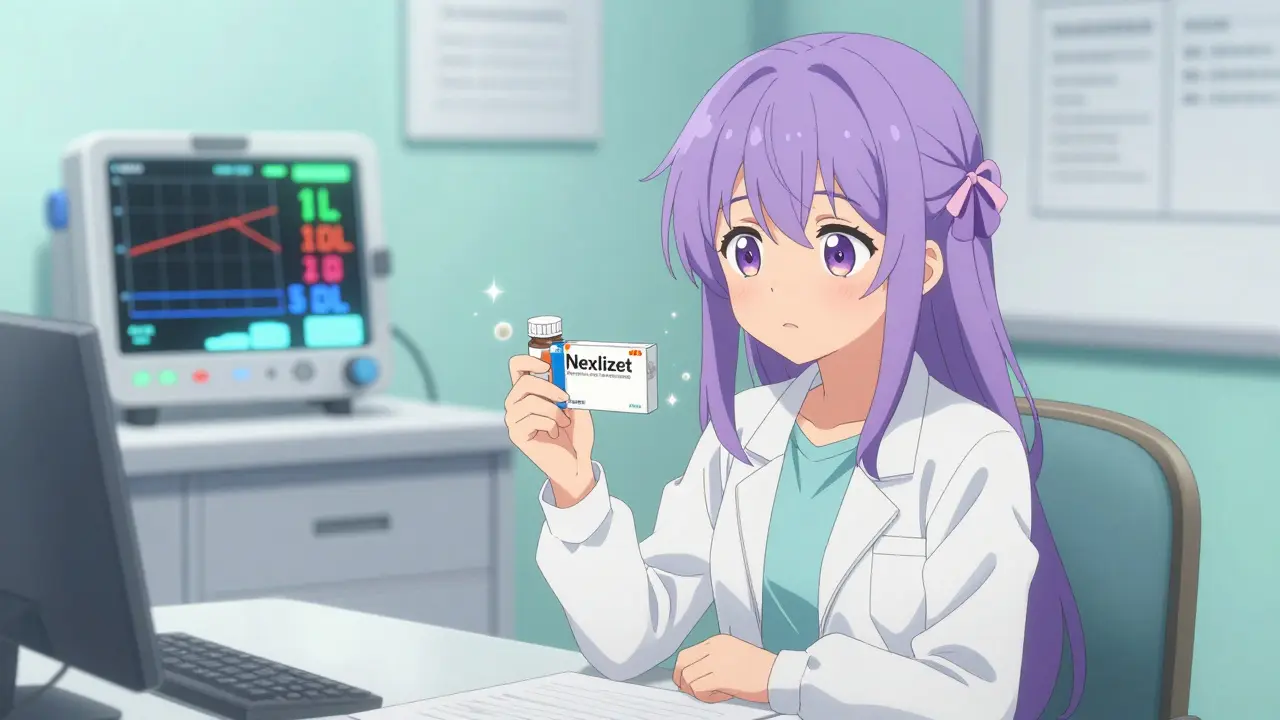
As a single pill, bempedoic acid lowers LDL by 17% to 23%. When paired with ezetimibe (in the combo drug Nexlizet), that jumps to 35% to 40%. That’s a meaningful drop - especially for people who can’t take statins at all.
The real game-changer came in 2023 with the CLEAR Outcomes trial. This study followed nearly 14,000 people with heart disease who couldn’t take statins. Those who took bempedoic acid saw a 13% reduction in major heart events - heart attacks, strokes, and deaths - compared to those on placebo. That’s not just about cholesterol numbers. It’s about living longer and avoiding hospitalizations.
And here’s the kicker: the benefit matched what you’d expect from statins. For every 1% drop in LDL, the risk of heart problems went down by a predictable amount. That’s why experts say bempedoic acid isn’t just a substitute - it’s a proven therapy.
Side Effects and Safety: What You Might Not Hear
No drug is perfect. Ezetimibe is generally well-tolerated. The most common issue? Mild stomach upset. That’s it.
Bempedoic acid has a few more concerns. In clinical trials, about 12% of users reported joint pain - higher than the 2% seen in placebo groups. Tendon problems, including ruptures, happened in about 0.5% of users. That’s rare, but serious enough that the FDA requires a Risk Evaluation and Mitigation Strategy (REMS) program for this drug.
Another issue: it can raise uric acid levels, which might trigger gout in people who are already prone to it. About 2% of users in trials developed gout. If you’ve had gout before, talk to your doctor about monitoring your levels.
Also, bempedoic acid interacts with certain statins. If you’re taking simvastatin, you can’t go above 20 mg per day. With pravastatin, don’t exceed 40 mg. That’s because bempedoic acid can make those statins stick around longer in your body, increasing the risk of side effects. It also boosts rosuvastatin levels by 74%. So if you’re on any statin, your dose may need adjusting.
Cost Comparison: The Real-World Challenge
Here’s where things get messy. Ezetimibe? You can get it for $4 a month. Generic, no insurance needed.
Bempedoic acid? Without discounts, it costs about $231 a month. Even with GoodRx coupons, it’s still $150-$200. That’s a huge barrier. On GoodRx, 76% of negative reviews mention cost. Many patients say they’d use it if it were cheaper - but they can’t afford it.
Insurance often blocks it unless you’ve tried and failed on statins and ezetimibe. Even then, prior authorization is common. Some patients get stuck paying full price for months before approval.
That’s why some doctors start with ezetimibe - it’s cheap, safe, and works. If LDL doesn’t drop enough, then they add bempedoic acid. For others, especially those with heart disease and no statin options, bempedoic acid is worth the cost.
Who Should Consider These Medications?
These drugs aren’t for everyone. They’re meant for specific situations:
- You’ve tried at least two different statins and had muscle pain or other side effects that made you stop.
- You have heart disease or are at very high risk (like diabetes with other risk factors) and your LDL is still too high even on the highest tolerated statin dose.
- You’re allergic to statins or have a rare condition that makes them unsafe.
Doctors don’t start with these drugs. Statins still come first - because they’re more powerful, cheaper, and have decades of proof they save lives. But if statins aren’t an option, these two are the most practical oral choices.

What About Other Alternatives?
There are other cholesterol drugs out there - like PCSK9 inhibitors (evolocumab, alirocumab). These are injectables that lower LDL by 50% to 60%. But they cost over $14,000 a year. Most people can’t afford them without special insurance approval.
Fibrates? They’re better for triglycerides than LDL. Inclisiran? It’s a twice-a-year shot that lowers LDL by 50%, but it’s brand new and expensive.
For most people who can’t take statins, ezetimibe and bempedoic acid are the only realistic oral options. They’re not perfect - but they’re the best we have right now.
Monitoring and Expectations
Don’t expect miracles. If you’re switching from a statin to ezetimibe or bempedoic acid, your LDL will likely drop less. That’s normal. Your doctor will check your lipid panel after 4 to 12 weeks to see if it’s working.
For ezetimibe, a 10% drop in LDL is considered a good response. For bempedoic acid, aim for at least 15%. If you don’t hit that, your doctor might add the other drug - or consider a PCSK9 inhibitor if you qualify.
Also, stick with it. These drugs take time. Some patients on bempedoic acid report feeling better after three months - not because their cholesterol dropped dramatically, but because they finally feel free from muscle pain.
The Future: What’s Coming Next?
The combo pill Nexlizet (bempedoic acid + ezetimibe) got FDA approval in 2024. That’s a big step - one pill, two mechanisms, better results.
Researchers are now studying whether bempedoic acid can actually shrink plaque in arteries. The CLEAR CardioTrack trial, with results expected in late 2025, is using ultrasound to measure changes in artery walls. If it shows plaque regression, that’ll be another win for the drug.
Market analysts predict bempedoic acid could be used by 35% to 40% of statin-intolerant patients by 2027. That’s a lot of people. And as more real-world data comes in, insurance companies may start covering it more easily.
For now, the message is clear: if statins don’t work for you, you’re not out of options. Ezetimibe is the affordable, safe starting point. Bempedoic acid is the more powerful, proven alternative - if you can afford it.
Can ezetimibe or bempedoic acid replace statins completely?
They can replace statins only if you can’t tolerate them. Statins are still the first choice because they lower LDL more and have stronger evidence for preventing heart attacks and deaths. Ezetimibe and bempedoic acid are second-line options - effective, but not as powerful.
Do these drugs cause muscle pain like statins?
Ezetimibe rarely causes muscle pain. Bempedoic acid is designed to avoid it - because it’s activated only in the liver, not in muscles. In clinical trials, muscle pain rates were similar to placebo (5.1% vs. 6.8%). Real-world reports show slightly higher joint pain, but not the classic statin muscle issues.
How long does it take to see results?
You’ll usually see your LDL drop within 2 to 4 weeks. But doctors wait 4 to 12 weeks before deciding if the dose needs adjusting. For bempedoic acid, the full cardiovascular benefit takes months to years to show - that’s why long-term studies like CLEAR Outcomes were so important.
Is bempedoic acid worth the high cost?
If you have heart disease and can’t take statins, yes - because it reduces your risk of heart attack and stroke. If you’re only mildly high-risk and your LDL is borderline, ezetimibe may be enough. Cost is a real barrier, but some patients qualify for patient assistance programs from the manufacturer. Always ask your pharmacist.
Can I take ezetimibe and bempedoic acid together?
Yes - and in fact, they’re now available in one pill called Nexlizet. Taking them together lowers LDL by 35% to 40%, which is more than either drug alone. This combo is often used when statins aren’t an option and you need a bigger drop in cholesterol.
Do I need to change my diet if I take these drugs?
Absolutely. These drugs work better when paired with a heart-healthy diet - low in saturated fats, high in fiber, and rich in plants. Ezetimibe works by blocking dietary cholesterol, so eating less cholesterol-rich food (like eggs, shellfish, full-fat dairy) helps. Bempedoic acid works better when you’re also managing your weight and blood sugar.