When you switch health plans, your monthly premium isn’t the only thing that changes. Your generic drug coverage can shift dramatically - and that could cost you hundreds or even thousands of dollars a year if you’re not careful. Many people focus on doctor networks or hospital coverage, but if you take regular medications, your formulary - the list of drugs your plan covers - matters just as much.
Why Generic Drugs Are the Key to Saving Money
Generic drugs make up 90% of all prescriptions filled in the U.S., but they only account for about 23% of total drug spending. That’s because they’re far cheaper than brand-name drugs - often 80-85% less. But here’s the catch: not all plans treat generics the same way. Some charge you $3 per pill. Others make you pay $40. Some waive your deductible for generics. Others don’t cover them until you’ve spent $2,000 out of pocket.If you take metformin for diabetes, levothyroxine for thyroid issues, or lisinopril for high blood pressure, your out-of-pocket cost can swing wildly depending on your plan’s formulary. A plan that lists your generic drug in Tier 1 might cost you $5 a month. The same drug in Tier 3? $35. And if it’s not on the formulary at all? You pay full price - sometimes over $100 a month.
How Formularies Work: Tiers Explained
Most health plans use a tier system to organize drugs by cost. The more expensive the drug, the higher the tier - and the more you pay. Here’s how it typically breaks down:- Tier 1: Preferred generics. Usually $3-$20 for a 30-day supply. This is where you want your medications to be.
- Tier 2: Non-preferred generics or low-cost brands. Often $20-$40.
- Tier 3: Preferred brand-name drugs. Usually $50-$75.
- Tier 4: Non-preferred brands or specialty drugs. Can be $100+ or a percentage of the cost (coinsurance).
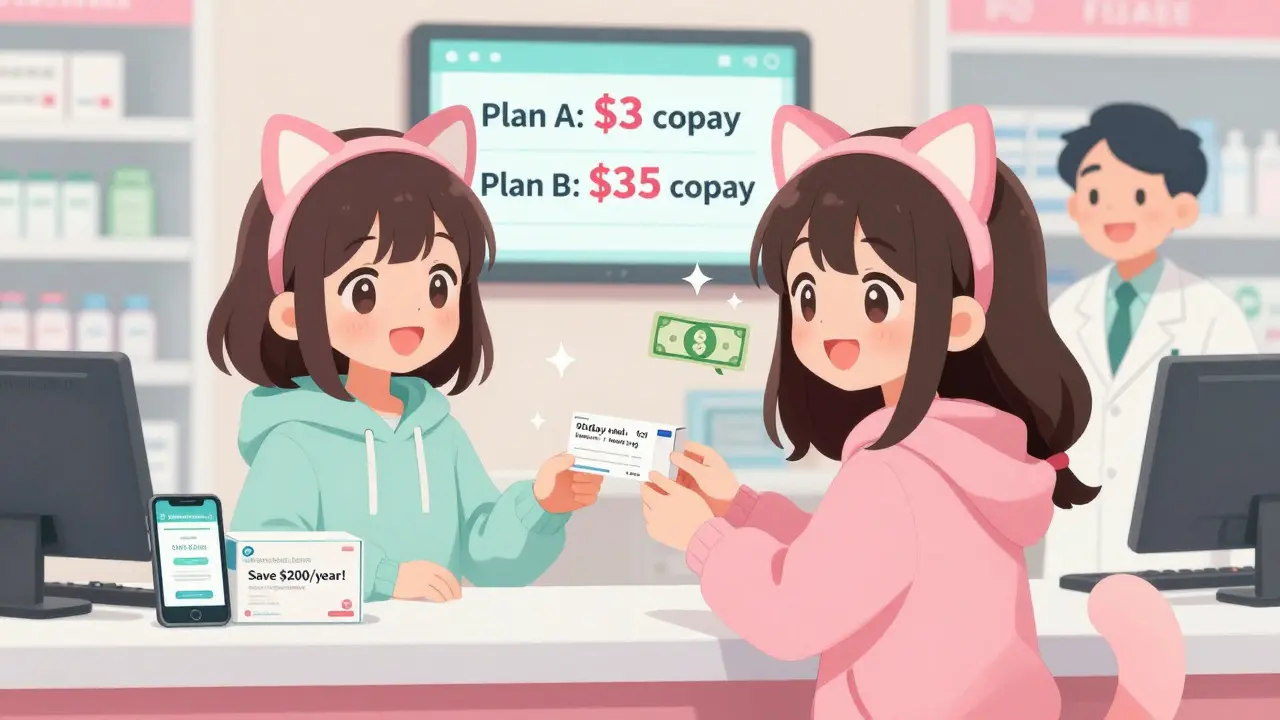
Some plans, especially Medicare Advantage or high-deductible plans, have five tiers. That means even generics can be split - preferred generics on Tier 1, non-preferred on Tier 2. The difference? A $10 copay versus a $35 one. And if your drug moves from Tier 1 to Tier 2 between years, your bill jumps overnight.
What’s the Deal With Deductibles and Generics?
This is where things get tricky. Many plans - especially high-deductible health plans (HDHPs) - make you pay the full deductible for medical AND prescription costs before coverage kicks in. That means if your deductible is $2,000, you pay $2,000 out of pocket before your $5 generic copay even starts.But not all plans are like that. Silver Standardized Plans (SPDs) on the Health Insurance Marketplace are required by law to waive the deductible for Tier 1 generics. That means you pay your $20 copay right away - no deductible needed. This can save low-income users over $1,200 a year, according to KFF.
Meanwhile, Medicare Part D plans have a $505 deductible in 2023, but most offer $0-$10 copays for generics after that. Some even have no deductible at all. But if you switch from a Medicare Advantage plan with no deductible to a standalone Part D plan, your costs could spike.
State Rules Change Everything
Your state isn’t just a location - it’s a rulebook. California requires a $85 deductible for outpatient drugs before coverage starts, and then you pay 20% coinsurance up to $250. New York, on the other hand, waives the deductible for generics entirely and caps copays at $75 for specialty drugs. In Washington, some plans offer $0 generics right out of the gate.If you’re moving states or switching plans within a state, don’t assume your current copay will carry over. One user in Oregon switched to a new plan and found their $3 generic metformin became a $25 non-preferred generic because the manufacturer changed. Same active ingredient. Different formulary tier. $200 more a year.
How to Check Your Medications Before You Switch
Don’t guess. Don’t assume. Do this before you enroll:- Get the full formulary. Not just the summary. Look up the complete list of covered drugs. Most insurers have a searchable PDF or online tool.
- Search by exact drug name and manufacturer. Metformin from Manufacturer A might be Tier 1. Metformin from Manufacturer B? Tier 2. Same drug. Different price.
- Check the pharmacy network. Your plan might cover your drug, but only at CVS. If your local pharmacy isn’t in-network, you could pay 300-400% more.
- Calculate your annual cost. Multiply your monthly copay by 12. Add any deductible you’d have to meet. Don’t forget mail-order options - some plans charge less for 90-day supplies.
- Compare your current plan to the new one side-by-side. Use tools like Medicare.gov/plan-compare or Healthcare.gov’s plan selector. They let you plug in your drugs and see real cost estimates.
People who complete all five steps reduce unexpected prescription costs by 73%, according to CMS data. Those who skip even one? They’re gambling.

Common Mistakes People Make
- Thinking all generics are equal. The FDA says they’re bioequivalent, but insurers treat them differently based on cost agreements with manufacturers.
- Ignoring strength differences. A 500mg metformin tablet might be covered. The 1000mg version? Not covered - or higher tier.
- Not checking for formulary changes. Plans update their lists every year. Just because your drug was covered last year doesn’t mean it will be next.
- Assuming mail-order is cheaper. Sometimes it is. Sometimes it’s not. Always compare retail vs. mail-order prices.
- Overlooking pharmacy restrictions. Some plans only cover drugs at certain pharmacies - like Walgreens or CVS. If you use a local independent pharmacy, you might pay full price.
What’s Changing in 2025 and Beyond
The Inflation Reduction Act capped insulin at $35 a month starting in 2023 - a huge win. By 2025, Medicare Part D will cap total out-of-pocket drug costs at $2,000 a year. That’s going to help people on multiple medications.Also, Silver SPD plans are expanding. In 2023, 24 states offered them. In 2024, it’s 32. More people will get access to deductible waivers for generics.
But there’s a downside: formularies are getting more complex. Some plans are splitting generics into three or even four tiers based on therapeutic equivalence ratings. That means your $5 generic could become a $25 generic next year - and you won’t know until you open your enrollment packet.
What to Do Right Now
If you’re thinking about switching plans - whether it’s through your employer, Medicare, or the Health Insurance Marketplace - take 30 minutes today to:- Write down every medication you take, including the exact name, strength, and manufacturer.
- Find your current plan’s formulary and note your copays.
- Use a plan comparison tool to plug in those drugs and see what your new plan would charge.
- Call your pharmacy and ask: “If I switch to Plan X, how much will my metformin cost?”
It’s not glamorous. But it’s the difference between paying $60 a month for your meds - and $240. That’s $2,160 a year. That’s a vacation. A new tire. A month’s rent.
Generic drugs are the most cost-effective part of your health plan. But only if your plan lets you use them without a fight.
How do I know if my generic drug is covered by a new health plan?
Look up the plan’s complete formulary - not just the summary. Search for your drug by its exact name and manufacturer. For example, metformin made by Teva might be covered, but metformin made by Mylan might not be. Use the insurer’s online formulary tool or call customer service with your drug details. Don’t rely on tier labels alone - they can be misleading.
Are all generic drugs the same price across different plans?
No. A generic drug can cost $3 in one plan and $40 in another - even if it’s the same active ingredient. This depends on the plan’s contract with the manufacturer, whether the drug is preferred or non-preferred, and whether your pharmacy is in-network. Always compare copays across plans before switching.
Do I have to meet my deductible before my generic drugs are covered?
It depends on the plan. In most high-deductible plans, yes - you pay the full deductible before any drug coverage starts. But Silver Standardized Plans on the Health Insurance Marketplace are required to waive the deductible for Tier 1 generics. You pay your copay right away. Always check the plan’s summary of benefits to see if prescriptions are subject to the medical deductible.
Can my generic drug be removed from my plan’s formulary after I switch?
Yes. Plans change their formularies every year during open enrollment. A drug covered this year might move to a higher tier or be dropped entirely next year. That’s why you need to check your formulary again every fall - even if you’re staying with the same insurer.
What if my drug isn’t on the formulary at all?
You’ll pay full price - which could be hundreds of dollars a month. You can request a formulary exception from your insurer, but that takes time and documentation from your doctor. Your best bet is to switch to a plan that covers your drug before you enroll. If you’re on Medicare, you can also use the Medicare Plan Finder to compare plans that cover your exact medications.
Are there tools to help me compare generic drug costs between plans?
Yes. Medicare beneficiaries can use Medicare.gov/plan-compare. People on Marketplace plans can use Healthcare.gov’s plan selector. Private insurers like UnitedHealthcare and Blue Cross also have online formulary checkers. These tools let you enter your drugs and see estimated monthly costs. Use them - they’re accurate and free.